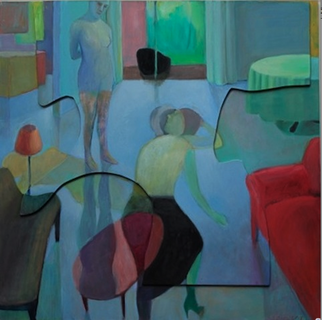
"I look for a subconscious quality in places and people. Figures moving and scenes unfolding in magic realism tones. [...]
My work has nostalgia, sometimes interrupted/augmented with use of found materials and overlaid shapes. My key interest is in relationships; individuals with their environment, conscience and or social contexts, whose tensions shape the narrative. [...]
I am intrigued with how inner proccesses come to light through relationships. I often include found materials in my surfaces to bring my surroundings to the image. Its otherness works unpredictably and gives meaning to the contradictory nature of experiences.”
A long-established Salt Spring painter and visual artist, Stefanie Denz was born and raised in Duncan, British Columbia. After completing the University of Victoria Fine Arts Program, Denz won a Commonwealth scholarship for an MFA at the University of Auckland, New Zealand. She has worked in many collaborative arts projects and her work has been exhibited in New Zealand, the US, Germany and Canada. Here is a link to her website."Strange" is the adjective I've most often heard in connection to Stefanie Denz's paintings, usually followed by other words like "beautiful," "alluring," "seductive," and "surreal." This post is an attempt to explore the complex sense of strangeness and allure that seems to envelop the work of Stefanie Denz through an analysis of one of her most emblematic paintings, "Flower." What follows is intended as a series of reflections suggested by the painting, not an authoritative interpretation of the work. In a way, I am reading the painting as I would a poem or piece of prose, starting with a specifically rich word or feeling and following its movement across the text. Maybe not the most orthodox way to analyze a work of art, but one that is, I think, close to Denz's own method. Let's see where it takes us.The Uncanny: the feeling of unease that arises when something familiar suddenly becomes strange and unfamiliar. A blurring of the boundaries between real and dream worlds. An opening, a tear in the fabric of everyday reality that reveals other, hidden "realities" beyond appearances.
When I look at Stefanie Denz's painting "Flower," the word uncanny immediately comes to mind. What do I find unsettling about this painting? Where does its familiar unfamiliarity lie? It is obvious that I am not looking at a realistic portrayal of a social gathering, even though both setting and people are depicted in a realistic, if somewhat stylized manner. I am looking at something more, something
other. In a recent talk at Salt Spring Island's local library, Denz described the painting as a drama between a mother (the woman in the yellow dress) and her son in a (kind of) domestic setting. Denz is interested in relationships and how these can be rendered on the flat surface of a painting, so her analysis of the scene focused on its realistic and narrative elements. The other figures in the quartet, the sleeping father and the girl crawling towards the door, are secondary characters in this family drama. Perhaps the mother is jealous of the girl (her son's love interest?) and this is why she is leaving the room. Maybe the whole scene is a dream created by the father—the shadowy figure lying on his side at the front of the room. (S. Denz, "Women in my Paintings: Narratives of Discovery within Covert Spaces," Salt Spring Island Library, August 5, 2015). Denz provided several clues to help guide the viewer into its complexities, but, in the last instance, I felt that the scene was still open to interpretation. I could sense there was something more, an opening, an unfolding on the canvas— an insistent presence that defied explanation. What was it? What is it?
That giant flower in the middle of the painting. Why didn't I see it before, opening its petals and enveloping the actors in the drama within its own unfolding space? It seems that I was always already looking at a painting of a flower (the title held the clue all along) ; I just made the conscious decision to focus on the meaning of the story. But I was missing something important. This change in perspective was enough to shift my attention away from the painting's narrative possibilities to its visual aspects. I moved from the seen to the unseen. As Paul Klee once remarked, the purpose of art is not to "reproduce the visible" but to "make visible" (
The Diaries of Paul Klee, Google Books). I suddenly became aware of other worlds, other realities shimmering beyond the visible world depicted in Denz's domestic scene and materializing, as a flower, into one of those "moments of being" that Virginia Woolf believed reside behind
"the cottonwool of daily life," her phrase for the banal trivialities of daily existence (Moments of Being, 72). Or perhaps the flower is a manifestation of something else entirely, something more sinister. Whatever it "is," the flower's refusal to be pinned down, to fit neatly into the scene's dramatic composition, remains its most fascinating if unsettling feature."I'm interested in places beyond real time," Denz explained in the introduction to her talk at the library. Interior spaces, places that evoke "psychic time." Is the flower a visual evocation of our unconscious, that realm of buried memories, dreams and secret desires suggestively described by Julia Kristeva as "[a] strange land of borders and otherness" where the self is "ceaselessly constructed and deconstructed"? (Strangers to Ourselves, 191) It would seem so. Psychic time does not follow a linear or chronological pattern. Our mental life, including its unconscious processes, as Freud noted, "is timeless," not subjected to traditional limitations of time and space. This atemporality gives our dreams—the way the unconscious makes itself manifest—their characteristically static and frozen appearance. Not unlike the flower in Denz's painting, I notice. Its centre and one of its petals—or the petal-like shapes extending from it—appear solidified, or in the process of becoming so, as if they were carrying too much "psychic" weight. Though not all the petals share this quality; some are light and airy, while others have a consistency between solid and liquid. Like a pool of oil. Almost viscous. Like a membrane. T
he petals' malleability, their shifting plasticity suggests that Denz has a more dynamic vision of our psychic world. After all, as Freud and other psychoanalysts (even neurologists) have noted, the unconscious is not a monolithic structure but a dynamic field, a reservoir of energies and drives connected to both mental and bodily processes. Is the flower a physical manifestation of these complex dynamic processes, that is, is it their material representation? Oil on panel, paint on a material surface. These are real, tangible substances. Now I understand the relationship between nostalgia and Denz's use of reclaimed materials in many of her paintings, "my work has nostalgia, sometimes interrupted/augmented with use of found materials and overlaid shapes." A shape can bring us back to the material and visual realities of the canvas, suspending the dramatic action and letting it rest in one emotionally-charged moment.
Nostalgia resides in the deepest parts of our psyche. Like the unconscious, or the uncanny, the nostalgic feeling manifests itself in the most unexpected of circumstances, as a sudden surge of emotion that feels almost like physical pain (the word nostalgia comes from the Greek algos [pain] and nostos [return]). Not unlike a poetic image, "an emergence ... a flare-up of being in the imagination" (Gaston Bachelard, The Poetics of Space, xviii), nostalgia emerges fully formed, a core of fluctuating emotions. I see now that the flower could also be a manifestation of nostalgia as "a flare-up" on the flat surface of the canvas. Denz has not superimposed extra materials on the painting (see "My Mother," below). Instead, she has set out to create the sense of space filling and growing (becoming three-dimensional) through the careful use of shape and colour. The effect is striking. Past memories, fears, tensions and desires are gathered together to form a flower, the traditional symbol of love in Western culture. Yes, now I see its timeless symbolism coming to the surface and the word that emerges is "connection":"Only connect! That was the whole of her sermon. Only connect the prose and the passion, and both will be exalted, And human love will be seen at its height. Live in fragments no longer. Only connect..."E. M. Forster, Howards End I look at "Flower" again and I sense E. M. Forster's impassioned appeal to connect, to gather, to bring together, but the human psyche is too complex and contradictory to be explained away by a call to universal love, nostalgia, or any other all-embracing concept. And Denz knows this, even as she tries to explain the painting to her audience at the library. She knows that there will always be something in this painting that resists interpretation, an "u
nruliness" that even the artist cannot tame. "Real art," as Susan Sontag remarks, "has the power to make us nervous." The act of interpretation, with its emphasis on intention and meaning, can be no more than an attempt to "tame" art's fundamental intractability, "Interpretation makes art comfortable, manageable" (Against Interpretation and Other Essays, 8 ). Stefanie Denz's paintings of social and domestic spaces are neither manageable nor comfortable. They refuse to give in to easy explanations— they remain "strange," undomesticated."To make strange" is one of the functions of art. Each artist explores this strangeness in a different, highly personal way. Denz's work focuses on the unseen psychic forces that permeate our domestic and social spaces, turning them into the scenes of complicated and mysterious dramas overlaid with strange and shifting shapes. The strangeness of her paintings, their "uncanniness," lies in their capacity to make visible the invisible while still remaining rooted in everyday reality. They are simultaneously familiar and unfamiliar, tangible and intangible, real and dream-like. Unpredictable and changeable, like us. But they are still works of art, grounded in the here-and-now of our present human reality. That is something that no flight of imagination can change.
Sometimes, art is not here to "mak[e] us more intelligible to ourselves" but to "help[...] us become more curious about how strange we really are” (Maggie Nelson,
The Art of Cruelty). Stefanie Denz's art does just that: it eschews easy explanations to focus our attention on just "how strange" "real" human experience can be. And that is wh
y her paintings of interior spaces will continue to seduce us with their alluring colours, shapes and precise compositions, while at the same time displaying their radical strangeness, their "uncanny poetry." 


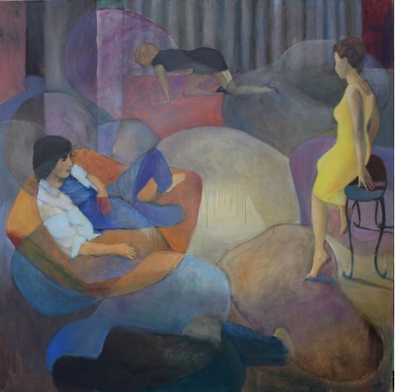 "Flower," oil on panel