Tuesday, 23 September 2025

Wheels -a peek at the little I know of death.

I have been cleaning up my studio, gathering papers to burn when I found a bit of my writing that caught my attention; 'We are very uncomfortale at the thought of dying,like all creatures on the planet we want to stay alive. We have relied on technology to make our niche, and kept socially adept to survive. In this development we have become more separate from our immediate environment which is percieved instead (not so sure about the instead)as threatening to our existence. Indeed, it is often challenging and ultimately kills us, as the act of breathing the air around us itself, causes oxidization. Our problem of anxiety around dying becomes a greater burden than dying itself, which we know is inevitable. Not accepting this causes estrangement (what do I mean?!!) from ourselves as physiological beings.' I wonder is it that we need to remember that not only does the environment sustain us, we are part of it? Yet we are quite reluctant to accept this obvious truth - think of all the age defying efforts, potions and myths that swarm around us leaving us confused and a little poorer in cash and time. Part of savouring life is acknowledging the connections as a felt, body based, experience in which we can relax and enjoy, revelling in the physical sensations, and positive thoughts and feelings. However, the flip side of this joyousness is quite overwhleming. There is no escaping dying and knowledge of disease, accident and violence are horrifying, adding to the terror of the ravages of aging in sags, wrinkles, aches, arthritic joints, milky eyes and so on. Being in this understandably anxious state about death we are less connected to physical sensations. But oddly there is reprieve as we life still hold gifts whether in sickness, pain or other less than perfect state; we realize it is not so bad, and there is in fact some freedoms. The point is we hang onto the life we have been given. This brings me to the question of being able to die - leaving our physical state, as present as possible rather than in anxiety. This must be the estrangement I wrote of. Can dying be likened to labour? During labour one stays as present as possible to the pain, to feel the effects of birthing for what they are worth, which can be alot. In the other option of panic, of deserting our body, we think we are going to die. To state the obvious our transition to death in the felt sense, is largely unknowable. Is there something greater birthing us into our death, a reverse as it were of our entry? There are such things as death doolahs, who act as midwives of dying making the soon to be corpse as comfortable as possible. Something I am sure about, is that death is messy, a deterioration, and it is the greatest personal mystery that happens to us. I sense the aura of uncanniness belonging to this final stage. We make places to hold a body, and acknowledge a life, even a child may want a grave for its dead guinea pig. Perhaps the grave is a place in which death's unknowableness for a particular sentient being can also dwell. This is what that dead being now holds. What can't be known outside us has a counterpart within us. I have always been curious that if there are things we do know in a rational way; what is the nature of non knowledge or death within us? Rilke sees death as being a fruit; "For we are only the leaf and the bark. The great death which each bears in himself is the fruit around which all revolves." Rilks suggests there is producuction, a fruition as it were, it is an unknown counterpart inside our bodies, not still, but moving in and out into the known, giving impetus to our choices. Or maybe it accompanies our choices like wheels.

Ready to botch things up- what goes on in my thoughts and body while I paint.

July 11 The de-gluer I had put on ‘mezzanine’ took the paint off in different layers and I am heartened it is better. Before it was over painted. It had had a good moment way back when before now. My shoulders hunch. My mouth is set at the thought. Now the surface is open again and I flip it onto the table. Freedom back in my arms. I repaint the stairs lightly in blue. Keep it light. The railings are too high, but the green is good. I feel my lower back relax. Getting some of those rose tones again, and some white in the ceiling. It's good. My stomach, and below it feel bottomless. In a good way. I eye the far wall- it’s still too close. How can I adjust that? I push the ceiling back, and the gable gets flatter. Is it the wrong angle? I am unsettled. The angle needs to return. My elementary school classmate and doyenne Kelly Taylor’s upper middle class house (it had a powder room in the seventies) and Anselm Kiefer’s attic meet in my mind.
I squint. The rose is still there, that white needs to tone down, a bit of ochre on the stairs to give them solidity, but not too much, so they still float, ooh, but that side aisle is wonky. Use the right colour when you fix it, I coach myself, or you will get side tracked. Maybe the stairs were better ghostly, but the tone was too dark. Damn the ochre has to go. It's not a bloody rainbow. My hand aches a little. I am tired. Time for a cup of tea. I have come back to it after many days. A quiet in September is settling in. I scratch at what remains on my palette. Quite dried up, but the white still lives. The corridor is good, more white right to the back window and some on the wall, plus some sap green. The balustrade looks somewhat attached to the floor, the corner is hard to make sharp. I put a bit of dark at the foot, then the wall goes wonky. Cobalt blue verticals upright it. The paint does not seem to want to stick to my brush. The magenta stairs need to be that blue green. I centre them better and add ochre where the foot goes. The face outward is now blue. I have lost track of the colours from before…. . Below the floor the lower walls recede. Oh, they are too short. Now off kilter. Sam told me about her daughter today, that she has disordered eating. I had just mentioned how I was doing personal boundary exercises with my child who suffers in a similar way. I rage, what is being put upon our girls? Oh, yeah, also Jane at work told me about her daughter….is it fashionable? It is, but us moms talking about it feels more helpful. We are not giving it shock and awe. The truth is sad and too common. Jane shared her challenges as a teen; her mom was critical of her body. Things like this run in the family. That sank into me, as I take in Jane's muscular body and recall how much physical appearance had mattered in my family. I am very grateful of her bravery to talk of this which feels so shameful. There is a lot of green now. I keep using the same brush, enjoying the grab and give, but different colours are needed. White on the one upper vault, on the side windows, and at the bottom is ok. I jiggle a bit. I yawn fiercely several times. It was a long day. Now I am here and am happy, but too tired. Typical. The stairs are angling up weirdly. I block them in with the green. Bring in white to take down the sides. Now it is ok. They are more integrated. I wanted them to float, but this is better. They zig up convincingly. I won’t be on them but something will be. They are perfect, if I can keep the background behaving. My brush feels careless at times, dangerous. Ready to botch things up. The fun is irresistible, but on the whole not worth it, and I have to keep the galloping to small doses. My body tingles at resisting. But any thoughts of following a less precise path feels like mud in my head. I look again, the whole thing is too green now. Hah. I scrub at the hardened acid yellow on my plastic palette. It gives way and now it leads me to the furthest back corridor. It may need a wall to be convincing enough. Not another wall! My shoulders hunch. There is an open basement door to the left, and the outdoors can be seen, without a horizon. Ahhh. My eyes are itchy. I rub them, making it worse. Probably a bit of paint on my fingers.

Monday, 11 August 2025

Further bits on being social

I keep my lines open to my children, absorbing their latest activites; dreams, losses, successes and dilemmas. I hope my hold is light, and they will continue blessing me with their sharing. When I am not at work, I organize connecting with freinds and acquaintances; walks, coffee, a meal or phone conversations. I seem to need these ongoing dialogues to glean the various angles of situations, trying to understand through the reflections of others how life events are being felt, how they are being assessed and what kind of ripples they might have. It appears my focus is getting pulled away by social activities, but they also keep me alert. They feel more like life lines that I depend on to understand my place in daily life. In my younger years I found it hard to stomach the roving needs, and opinions, the smell of others too strong. I had freinds, and I had getaway plans. Since then my fascination for human behaviour has become more acute, and I am not only finding meaning I am also uplifted by exchanges, and in the ambiance found in the details of time and place. I have become less afraid and more open and able to take steps I dreamed of when I was younger- a dream of a loving community. Though my seemingly reverse trajectory is not ideal for study and many hours of uninterrupted focus, it is providing me with inspiration. Still there is no solution to the limits of time, and I am taken back to my experience of being a mother with its profound and consuming intimacy. Having children was an intense and terrifying experience. Deeply in love with the little beings I was boggled at how I would maintain my drive for creative impulses, which required time and energy, and was directly at odds with the almighty demands of a child. I plotted, I did not sleep, I tried to do work while with them, which did have some success in creating shared creative environments, or at least a desire for that. All tricky. Below, is a portrait of myself pregnant with our third child in 1997. Knowing how much energy a child takes, that I was possessive and that we lived on an obscure island, adding up to poor odds for an artist. Continuing studio work was mad, and I desperately wondered how I was going to cope and keep any of my dreams and goals in sight. I felt rent between my ambitions and love for my children. I was frozen by my circumstances. But the enclosing basket is opening and there is pepper in my expression.
Paula Becker Modersohn (1875-1907), an exceptional artist, divided by the demands of being a wife and mother, and facilitating her artistic ambitions, was someone clearly aware of the cost of personal expression. She died shortly after giving birth to her first child in 1907. I shudder. The demands of being a mother are hardly as dire or life threatening today, with less rigid roles rewarding both parents, but career and family needs still present a challenging balance. Modersohn's self portrait is full of courage, and painting herself nude and pregnant was an act of celebration of her motherhood and artistic depth. The two are intertwined.

Wednesday, 25 June 2025

On being defiant

I entered my zoom session with my supervisors in the midst of my work day, semi prepared, pleased and nervous to see them. I had got some reading, some writing and some organizing done though the heaps that I am needing to do beyond that look like a big wiry mess impossible for me to untangle. Near the end of our time my document on 'felt sense in the studio' was brought up, and the fact that it was far more interesting to hear about what was actially happening in my painting and how it might reflect my inner felt sense more than I had anticipated. Whether I had made the read more interesting, or that what I had written before was too obscure, I said I'd not initially thought anyone would want to read about what I was painting. This sentiment is however not quite accurate; what I wanted was not to write about what was in the painting but have people look at it to figure it out, instead of reading about it. Then I realized my writing was not about what was in the painting either, rather it showed a relationship between my bodily sensations and emotions therein and the activity of the work. This is interesting. I have read a bit of Maurice Blanchot, and his study of the dynamism between creator and creation. I noted that he was indignant about something I take as a given; that we only know our work when we are in it. I in turn was indignant at his expectations that it should be any different! Truth is I am jealous that he allows that we do want to know our work. My supervisors noticed I was angry, resentful even, that Blanchot swims into expectations of impossible connections, whereas I have kept myself dutifully away from any unrealistic dreams, even ones that a boy might have. I was suprised to hear my anger was noticeable. I, the therapist of equanimity and calm, have another side, hidden mainly from myself. I chuckle inwardly; I have been called defiant before, which at the time, deeply puzzled me. Now I can be grateful to Blanchot for revealing my anger. I hope to be in my defiance when it happens.

Friday, 20 June 2025

the thought of an alcove

This came together over a longer period. I would come back to the collection on my studio floor day after day and it was never quite right. I would leave it, change it, and then see I had returned to what I had done before! I knew the parts could work, but it was not forseeable how. The bit with the metal handle was integral, but where ever I put it, the nails poked out too significantly, or made the whole thing become ungainly, and the addition itself was lost. I feared altering the parts, as they lose their sense of self with too much tampering. Eventually though, and I could not believe it, placing it on top of the board I was sure I'd keep clear, worked. I had the thought of an alcove in the middle of it all, and I think this is what convinced me I could find more than just enough wriggle room.
>

Noli me legere and 'the errant intimacy of the outside from which he could not make an abode'

I have dipped into Maurice Blanchot's 'Writing of Disaster', 1980, and reading about him and his ideas has provided a crutch as I struggle to follow his words, which feel more like solid corpusules not able to enter my head, or vapours that slip past my nose unidentifiable. Maybe that is the point. Because I believe that words do not, can not describe what life is, and apparently this is Blanchot's gig. For me words have given parts of my brain something useful to do, which if those parts are not engaged, gets sad. Likewise words are a speaking aspect of communicating, and communicating is something my whole self likes doing, and I am uplifted by the activity. Perhaps I have resisted embodying words. As it is, communicating is done in numerous ways; by being present, listening, responding physically with actions, vocalizing, and, besides speaking with words, writing. It seems when you are not present, or words do not match actions, the experience can veer into being draining. Other things make communicating onerous, that have more to do with the nature of the exchange, such as power imbalances, mood, willingness, the content- meaningfulness and urgency. For more satisfying communication an agreement on exchange needs to occur, setting the tone of the relationship. Blanchot touches on this in regards to the relationship between the creator and creation in 'The Space of literature, 1955, where he observes 'For the work is the very decision which dismisses him, cuts him off, makes of him a survivor, without work. He becomes the inert idler upon whom art does not depend. ' p. 24. This could describe how my art as a painter appears to me. But I don't take umbrage, I do not expect anything different. I am often closed out as Blanchot's writers are from their work, though I do enjoy some appreciation when the work is going well. Ultimately the painting does not care who makes it, just that it is made, and I benefit from its presence. Is making an artwork similar to being a parent, with all its hurdles of accepting, letting go, being available and then most ideally left behind? Reading further on the same page, I could relate to 'The writer cannot abide near the work. He can only write it; he can, once it is written, only discern its approach in the abrupt Noli me legere which moves him away, which sets him apart or which obliges him to go back to that "separation" which he first entered in order to become attuned to what he had to write. So that now he finds himself as if at the beginning of his task again and discovers again the proximity, the errant intimacy of the outside from which he could not make an abode." 'Noli me legere', latin literally means 'do not read me'.To be read is to be touched. I have been kept at bay with Blanchot's words. I was further intriqued by his reference to an abode, as I look for ways in which to 'dwell' somewhere as a matter of survival. This does imply a separation, a sheltering from the world, but this offers a way to be in the world, where I would otherwise die. Making an abode has parallels to develping intimacy which requires differentiating. In psychological terms, healthy relations demand boundaries(walls) in order for people or groups to become closer in respectful manners. There are many ways in which this evolves and gives expression, and is significantly felt culturally.
'Diamond with Entry', oil on small drawer facing. Maurice Blanchot did alot of writing, and when he kept himself separate for health reasons, he wrote to his freinds. It was no doubt beneficial to keep in contact, and the physical action therapeutic. I would suggest the act of writing itself had a positive effect on his body, as his mind and heart agonized over the effects of the war. In this regard his presentation of the content mirrors his relationship to the movement of hand and pen. I sense ambivalence and passion.

Wednesday, 21 May 2025

One or two eyes

'She is looking through me' observed my friend. She was referring to one of four figures in a painting I'd been working on. All of them are looking at something and where their eyes are directed is making a difference. One figure is behind a camera, and his "eye"is taking in the sight through a technical device. Another figure is looking at the two others which gaze out at the viewer. These two are layered on eachother, and the one in the fore is someone I know personally, and the one underneath symbolic. This last was causing trouble. She was looking at us, with one eye was obscured, and indeed she seemed to look past you. I tried various things; a hooded eye,closed, squinting, frowning, smiling, but the gaze was still blank. Finally I tried two eyes, and going from eye to eye she was suddenly less staring, though I had done little other than make sure both pupils were centred. Could it be the fact that by absorbing that she had two eyes, it became apparent that she could triangulate, and that we felt seen? Her eyes could now train in on us, whereas before that was not a sure thing? This then suggests how much our eyes are connected to our understanding of spatiality, and how much we rely on our eyes to give us a sense of how someone else is looking at us. The nature of the look is deternined by how we understand the eys function. However having four eyes trained on me was disconcerting. I briefly considered her face turned away but then she was less present. Then I wondered about a mask. Would she be too wooden? She was not. She became a presence that was not distracted and nor did it compete with the immediacy of the fore figure. I did not catch all the iterations, but here are four. I think I like the first one best!

Ambivalence to the present

My daughter is about to arrive, and I am very much looking forward to seeing her. There are some chores that need to be done before she comes. They may not be. But it would fulfil the picture in my mind if they were. Where to start? I am unmotivated to begin, and I am suddenly feeling at a loss, and I want to get away from the feeling I have that is unidentifiable at the moment. But I don't want to go to what I know, either, and neither do I want words for this that I do not know. I do not want to succumb to needing to know the way I normally do. Sitting with deeply ambiguous feelings- ones that are unformed, reforming, inidentifiable, is for the most part uncomfortable for me. I am uncertain of how to read what is happening, and I resist swinging to conclusions in order to find something concrete. There is also a time factor. It might be crucial I make decisions and if I do not know the feelings, I cannot proceed. The survival button gets pushed, whether that is necessary or not. Ambiguous feelings leave me ungrounded, and therefore possibly not as resident in my body. I wonder if it is this latter that makes me most uncomfortable. If I can stay in the moment, with awareness in the body, those times might be more bearable. Rather than easing or cloaking the anxiety produced with other activities or distractions, I could remain in the not knowing. I cannot say I am successful. Pema Chodron calls the unknowing the ground of being. Her words help me! This irritates me somewhat (somebody else's words have rescued me), but at the same time I realize that is a vanity and am wholly grateful for the words that guide me to that place of acceptance and in fact a deep peacefulness. I am left with the question of how we recognize an image and its meaning, and the use of language in that process. Language is visual, spoken and written. There is an area between feelings, image and words that have different functions in coming to one's 'ground of being'. I might call that a natural state of ambivalence to staying present, felt in the body.

Monday, 28 April 2025

The shape of feelings

I recently read a paper by Gernod Bohme 'Atmosphere as a Fundamental Concept of a New Aesthetics', Thesis Eleven, 36, 1993, p. 113-126. (German: 'Atmosphäre' Essays zur Neuen Ästhetik, Frankfurt/M, Suhrkamp, extended edition 2013.) and his ideas about the sensibility of space. He suggests that it has atmosphere, an aura, something vague (and often dismissed as a tangible formal aspect in art work) but still very much there. He suggests that things have an atmosphere before you arrive, and that we have a sense of it with our whole body. This rang true for me, and the knowledge I have of things, their inside outside qualities and the interactions that occur. Bohm quoted Hermann Schmitz another philospher who acknowledges the aura of things. I checked him out and a bottom line for him is that feelings are things or half things, making them something that can be talked about. He goes on to say that we may think our feelings are private, but they are shared, perhaps by physically observed giveaways, and the fact is humans have emotions and feel their effects, from others as well as themselves. Schmitz asserts that feelings are what motivate us, and in my experience I easily concur. Acknowledging feelings, and accepting them as ones own lived experience supports ones mental well being. Identifying the lived experience and the feelings with it (experiencing and living are synonymous and require feeling)as ones own makes them things. They are things one can dwell in, returning to what might be called memories. However though a memory and feeling 'thing' have crossovers, but they are not the same. The feeling thing may evoke emotions but it is not a particular emotion. I am starting to investgate these areas futher using words. As I gather up the various things(subjects) that fall into my paintings I keep returning to finding the mood of the piece as my dterminer of what can stay, and if the mood is not there I am lost. It is not something easy to articulate and I circle around understanding the sense of a place to make a start. Even that is not a sure thing. I am trying to discern something by feeling the exchange between spaces, and of the spaces within things that are also in exchange. From the exchange there is a shape of the feeling that is almost independent of the parts; an over arching shape. This is the true subject of the painting. The theories of Bohm and Schmitz support some of the knowledge I access through my creative methods, but they do not explain it. The painting below was originally a big pink ear hovering over a road through a narrow forested valley. It was not working. I added cut out pieces of plywood. Eventually the painting came to be the elusive quality of a relationship occurring in a particular time and place.
In the living room, oil on panel and plywood, 24''x24'', 2012

Monday, 21 April 2025

Psychic shelter

What is psychic shelter? It is a place where I do not have to make a decision if I don't want to. It's a place of possibilities, and though there is no immediate pressure to go one way or another, there is the sense that something will happen. It's not a predictable outcome but it's quite acceptable, and in the meantime I can stay here to feel the mechanics of the parts at work. I can approach the space at a speed that matches the unfolding of the scene as I take in the parts. I am not in danger, I am not bored, and I do not have the answers. I am part of the picture, giving witness to something I am not otherwise privy to. This comforts me. One of the first paintings I made that I can positively call psychic shelter, was on a small piece of flooring, and was of a rectangular building, with a low pitched roof, and a single open door. The building sat on a slightly raised platform in the centre ground fairly far away, on an open plain with a range of mountains in the distance. Colours were overall warm. I called it 'Giving My Father Shelter'. My dad, a foster child, teen soldier in WW2, and immigrant to Canada could be gruff and given to stony silences, deeply puzzling me. I loved him. Since that painting I have painted structures, and scenes to house, or hold feelings that are perhaps uncomfortable, close by, familiar and unknown to me, yet there. In this way a space is given to some vague thing, and there is recognition, which is a relief. There are other indiscernible things in the back ground keeping peace. I wonder if what might arise in feelings can cancel eachother out. Having an image come to me, always of a space for something to be, presents a chance to discover and hopefully redeem. The image comes with a feeling, though maybe its the other way around, the feeling has an image? The act of painting itself, the rhythmic movement, the subtle blending of colours, emerging shapes, give form to that first image, but its not right if the feeling is not there. The feeling/image holds all the things that are not here, things that I miss. Grieve. More psychic shelter for the love left behind for what has been lost. In therapy the first thing the therapist must establish with the client is a safe space, in order to build trust, as without trust there can be no therapy. In art therapy, the object of creativity (with therapist there maintaining the boundaries, and grounding the client) is the safe space. The creative process is where feelings are allowed and not judged. What the process does and objects made in art therapy is offer psychic shelter for the pain that is being released.

Tuesday, 25 March 2025

How things are shared.

The spaces between things in which exchanges and interchanges occur hold a potential (charge/energy) that acts on the various parts which duly share narratives of beliefs, histories, characteristics, through their positioning and resulting dynamics in the situation. There are static situations, but I am more interested in the shifting ones. How something is going to change is not predictable but one can observe the parts, the qualities of the relationships, and by the positioning and particulars of the figures, in the case of humans in the scene, what expectations there might be. These expectations are based on individual needs within cultural norms (Brecht) There is a correlation of movement in the body to soothe the mind, and with particular movements trauma is released from the amygdala. Certain repititous movement regulates the nervous system. Rituals that herald changes in life bring acceptance and some calm to the fear and insecurity that accomapnies change.
Mother Nature Giving Away Secrets , 48''x60'', 2011

Saturday, 15 March 2025

Reading Blog for phd workshop - fleeting space Gyungju Chyon

I was very taken by the readings for the workshop. Many of the quotes from archtitects; Palassmaa & Zumthor, and philosophers; Grifero & Bohme made a lot of sense to me. In my own love of architecture and as a painter my feelings concur about the perception of a space being before a knowing of what that really is. Atmosphere is what makes it possible to actually take something in. The space needs to have a potential for our imagination - our imagining to be in the space, that it has space for us, and that the space is already finding a place inside us before we are cogintively aware of it. The readings have given me further direction in my phd journey towards the unconscious and felt sense which underlies my studio practice and gives me a route to knowledge I have. I was not as interested in the projects around quasi thingness. I think I am looking for more storytelling in what is for the most part sensory/physically animated work. I believe my reaction might be different if I were to experience the produced pieces.
Pilgrimage, oil on Mylar, 42''x61''
Yellow roof with porch, oil on wood, 20''x16''

Frieda kneeling with dog

I am most curious about systems of give and take within narratives. Multi exchanges can generate interpretations, readjust given standards and accommodate a broader sensing of what is, in the sharing. Social media is purported to be two way, and more, but it's speed, ease and I would suggest disconnectedness, makes it an area prone not only to cyber bullying, but transactional exchanges that are deceptive. I am not referring to cyber crime, but rather the usually one directional exchange of sales, in which bodies (in our times often female) are relentlessly targeted as inadequate for better marketting outcomes. Painful conditions result. From the mind of a young woman; Becoming trapped in your body by fear of not being accepted, and therefore not surviving, are fueled by ideas of how your body should appear and function. Energy gets used up monitoring yourself instead of connecting with others and solving world problems. Energy is used up finding ways to meet the demands of the day. Plants and pets help take the pressure off.

Saturday, 15 February 2025

Wintry night

Verborgene Gefuhle (Ger. buried feelings)sounds right in my mouth. I would like to add attunement. It feels different in my mouth. Sly. Sometimes a deep loneliness, lostness, despair comes to me, and my thoughts glide anxiously to my lost babies. I wonder what preceded that feeling? In dialetical behavioural theory (Marsha Lenihan)a thought precedes a feeling, and a (hidden) belief underlies the thought. Thus I am urged to explore the powerful feeling overcoming me, and I am afraid of falling into a dark hole with an unknown end, somewhere my mind cannot grasp. I have been there before, and there was no thinking out of it. What is my underlying belief- I have betrayed my heart, and by staying on the edge I will never be able to redeem myself? I don't know, but the edge I am occupying at this moment is superficial, brightened by neon lights, not a real sun. I turn instead to what is gratefully the wintry landscape of February, and it feels real enough. I can abide in its starkness and ancient qualities and be accompanied. This is attunement regulating the nervous sytem. The darkness is a stage I can walk on, and I know I can trust it to not be happy. Not my husband, but simple things; the woodstove, root vegetables, cabbage and potatoes, hot broth and woolly socks wrap me. A commemoration to what I have been left with, a sad yearning I had not expected, '...the uniqueness of an individual's experience being key to the changes mourning brings, only in the details can they and their grief be understood.' (p.17) Attig T. (2010). How we grieve: Relearning the world (2nd ed.). Oxford University Press
Winter walk
Night house, oil on layered wood plywood, 18''x22''

Thursday, 13 February 2025

Utopia on the edge

Or 'Utopia in the Margins', oil on found plywood, 17''x20'' I had noticed this abandoned house up on a knoll off Old Lake Cowichan Rd, a former main thoroughfare to Lake Cowichan on Vancouver Island BC, and was smitten. I wanted to paint it. If you look closely you can just barely see it on the ridge, a beacon of something that had had worth. The location is cleared of otherwise dense forest for the hydro lines, and has a great view towards the river south and valley north. To me it looks very welcoming in its wildered surrounds. Its not an overpriced neighbourhood yet, and up close you can see it was a newer house, modest, but now left abandoned to the elements. Plants are creeping in, windows broken onto the carpet, small critters darting and mold growing. They couldn't pay their mortgage? It still has an air of being somewhere someone had chosen as special. Maybe for a family. This somehow makes it more full of dearly held hopes and dreams. I returned to the road and wandered up and down drawing from different spots, wanting a sense of that road that kept going, and the undemanding reprieve in the shelter to the side. Could I get the psycho-emotional swirl that was balanced between relief from the constant pressure of being on the road and the road's counter offer of an escape from lost dreams? What was the best angle to convey what that felt like physically in the body?

Tuesday, 11 February 2025

Nuria's blog post

This blog is from awhile ago, as is the painting, but it is still teaching me things, and clearly it is not always the most recent works that are the most relevant. I could see much that pertained to my PHD in Nuria's analysis; the changing viscosities of the flower, the emerging relationships, and the various scenes that do not resolve themselves. From her words I take some nerve to carry on.

The Uncanny Poetry of Interior Spaces. "Flower," by Stefanie Denz

9/1/2015

1 Comment

Picture"Flower," oil on panel

    "I look for a subconscious quality in places and people. Figures moving and scenes unfolding in magic realism tones. [...] 
    My work has nostalgia, sometimes interrupted/augmented with use of found materials and overlaid shapes. My key interest is in relationships; individuals with their environment, conscience and or social contexts, whose tensions shape the narrative. [...] 
I am intrigued with how inner proccesses come to light through relationships. I often include found materials in my surfaces to bring my surroundings to the image. Its otherness works unpredictably and gives meaning to the contradictory nature of experiences.” 


A long-established Salt Spring painter and visual artist, Stefanie Denz was born and raised in Duncan, British Columbia. After completing the University of Victoria Fine Arts Program, Denz won a Commonwealth scholarship for an MFA at the University of Auckland, New Zealand. She has worked in many collaborative arts projects and her work has been exhibited in New Zealand, the US, Germany and Canada. Here is a link to her website.

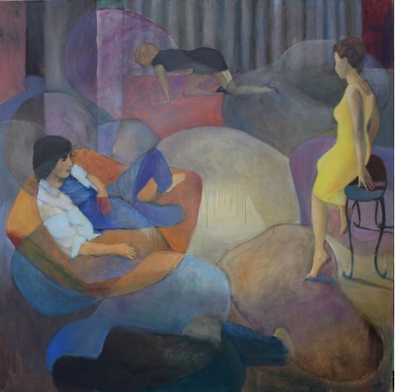
"Strange" is the adjective I've most often heard in connection to Stefanie Denz's paintings, usually followed by other words like "beautiful," "alluring," "seductive," and "surreal." This post is an attempt to explore the complex sense of strangeness and allure that seems to envelop the work of Stefanie Denz through an analysis of one of her most emblematic paintings, "Flower." What follows is intended as a series of reflections suggested by the painting, not an authoritative interpretation of the work. In a way, I am reading the painting as I would a poem or piece of prose, starting with a specifically rich word or feeling and following its movement across the text.  Maybe not the most orthodox way to analyze a work of art, but one that is, I think, close to Denz's own method. Let's see where it takes us.

    The Uncanny: the feeling of unease that arises when something familiar suddenly becomes strange and unfamiliarA blurring of the boundaries between real and dream worlds. An opening, a tear in the fabric of everyday reality that  reveals other, hidden "realities" beyond appearances.

When I look at Stefanie Denz's painting "Flower," the word uncanny immediately comes to mind. What do I find unsettling about this painting? Where does its familiar unfamiliarity lie? It is obvious that I am not looking at a realistic portrayal of a social gathering, even though both setting and people are depicted in a realistic, if somewhat stylized manner. I am looking at something more, something other. In a recent talk at Salt Spring Island's local library, Denz described the painting as a drama between a mother (the woman in the yellow dress) and her son in a (kind of) domestic setting.  Denz is interested in relationships and how these can be rendered on the flat surface of a painting, so her analysis of the scene focused on its realistic and narrative elements. The other figures in the quartet, the sleeping father and the girl crawling towards the door, are secondary characters in this family drama. Perhaps the mother is jealous of the girl (her son's love interest?) and this is why she is leaving the room. Maybe the whole scene is a dream created by the father—the shadowy figure lying on his side at the front of the room. (S. Denz,  "Women in my Paintings: Narratives of Discovery within Covert Spaces," Salt Spring Island Library, August 5, 2015). Denz provided several clues to help guide the viewer into its complexities, but, in the last instance, I felt that the scene was still open to interpretation. I could sense there was something more, an opening, an unfolding on the canvas— an insistent presence that defied explanation. What was it?  What is it? 

That giant flower in the middle of the painting. Why didn't I see it before, opening its petals and enveloping the actors in the drama within its own unfolding space? It seems that I was always already looking at a painting of a flower (the title held the clue all along) ; I just made the conscious decision to focus on the meaning of the story. But I was missing something important. This change in perspective was enough to shift my attention away from the painting's narrative possibilities to its visual aspects. I moved from the seen to the unseen. As Paul Klee once  remarked, the purpose of art is not to  "reproduce the visible" but to "make visible" (The Diaries of Paul Klee, Google Books). I suddenly became aware of other worlds, other realities shimmering beyond the visible world depicted in Denz's domestic scene and materializing, as a flower, into one of those "moments of being" that Virginia Woolf believed reside behind "the cottonwool of daily life," her phrase for the banal trivialities of daily existence (Moments of Being, 72). Or perhaps the flower is a manifestation of something else entirely, something more sinister. Whatever it "is," the flower's refusal to be pinned down, to fit neatly into the scene's dramatic composition, remains its most fascinating if unsettling feature.

"I'm interested in places beyond real time," Denz explained in the introduction to her talk at the library. Interior spaces, places that evoke "psychic time." Is the flower a visual evocation of our unconscious, that realm of buried memories, dreams and secret desires suggestively described by Julia Kristeva as "[a] strange land of borders and otherness" where the self is "ceaselessly constructed and deconstructed"? (Strangers to Ourselves, 191) It would seem so. Psychic time does not follow a linear or chronological pattern. Our mental life, including its unconscious processes, as Freud noted, "is timeless," not subjected to traditional limitations of time and space. This atemporality gives our dreams—the way the unconscious makes itself manifest—their characteristically static and frozen appearance. Not unlike the flower in Denz's painting, I notice. Its centre and one of its petals—or the petal-like shapes extending from it—appear solidified, or in the process of becoming so, as if they were carrying too much "psychic" weight. Though not all the petals share this quality; some are light and airy, while others have a consistency between solid and liquid. Like a pool of oil. Almost viscous. Like a membrane. The petals' malleability, their shifting plasticity suggests that Denz has a more dynamic vision of our psychic world. After all, as Freud and other psychoanalysts (even neurologists) have noted, the unconscious is not a monolithic structure but a dynamic field, a reservoir of energies and drives connected to both mental and bodily processes. Is the flower a physical manifestation of these complex dynamic processes, that is, is it their material representation? Oil on panel, paint on a material surface. These are real, tangible substances. Now I understand the relationship between nostalgia and Denz's use of reclaimed materials in many of her paintings, "my work has nostalgia, sometimes interrupted/augmented with use of found materials and overlaid shapes." A shape can bring us back to the material and visual realities of the canvas, suspending the dramatic action and letting it rest in one emotionally-charged moment. 

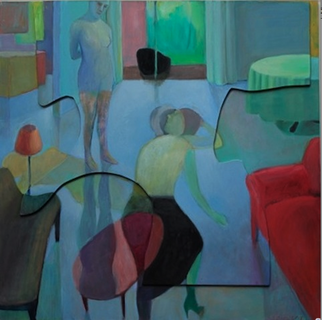
Nostalgia resides in the deepest parts of our psyche. Like the unconscious, or the uncanny, the nostalgic feeling manifests itself in the most unexpected of circumstances, as a sudden surge of emotion that feels almost like physical pain (the word nostalgia comes from the Greek algos [pain] and nostos [return]). Not unlike a poetic image, "an emergence ... a flare-up of being in the imagination" (Gaston Bachelard, The Poetics of Space, xviii), nostalgia emerges fully formed, a core of fluctuating emotions. I see now that the flower could also be a manifestation of nostalgia as "a flare-up" on the flat surface of the canvas. Denz has not superimposed extra materials on the painting (see "My Mother," below). Instead, she has set out to create the sense of space filling and growing (becoming three-dimensional) through the careful use of shape and colour. The effect is striking. Past memories, fears, tensions and desires are gathered together to form a flower, the traditional symbol of love in Western culture. Yes, now I see its timeless symbolism coming to the surface and the word that emerges is "connection":

"Only connect! That was the whole of her sermon. 
Only connect the prose and the passion, and both will be exalted, 
And human love will be seen at its height. 
Live in fragments no longer. 
Only connect..."
E. M. Forster, Howards End

 I look at "Flower" again and I sense E. M. Forster's impassioned appeal to connect, to gather, to bring together, but the human psyche is too complex and contradictory to be explained away by a call to universal love, nostalgia, or any other all-embracing concept. And Denz knows this, even as she tries to explain the painting to her audience at the library. She knows that there will always be something in this painting that resists interpretation, an "unruliness" that even the artist cannot tame. "Real art," as Susan Sontag remarks, "has the power to make us nervous." The act of interpretation, with its emphasis on intention and meaning, can be no more than an attempt to "tame" art's fundamental intractability, "Interpretation makes art comfortable, manageable" (Against Interpretation and Other Essays, 8 ). Stefanie Denz's paintings of social and domestic spaces are neither manageable nor comfortable. They refuse to give in to easy explanations— they remain "strange," undomesticated.

"To make strange" is one of the functions of art. Each artist explores this strangeness in a different, highly personal way. Denz's work focuses on the unseen psychic forces that permeate our domestic and social spaces, turning them into the scenes of complicated and mysterious dramas overlaid with strange and shifting shapes. The strangeness of her paintings, their "uncanniness," lies in their capacity to make visible the invisible while still remaining rooted in everyday reality. They are simultaneously familiar and unfamiliar, tangible and intangible, real and dream-like. Unpredictable and changeable, like us. But they are still works of art, grounded in the here-and-now of our present human reality. That is something that no flight of imagination can change. 

Sometimes, art is not here to "mak[e] us more intelligible to ourselves" but to "help[...] us become more curious about how strange we really are” (Maggie Nelson, The Art of Cruelty). Stefanie Denz's art does just that: it eschews easy explanations to focus our attention on just "how strange" "real" human experience can be. And that is why her paintings of interior spaces will continue to seduce us with their alluring colours, shapes and precise compositions, while at the same time displaying their radical strangeness, their "uncanny poetry." 

Picture
"My Mother"

Tuesday, 21 January 2025

Reading diary for January 26&27 Mishandled Archive: A journey from a multi-disciplinary PhD project to publication WITH alessandra cianetti and Tara Fatehi

 I am looking forward to learning more about an area that can feel opaque for me- the corporeal meeting the written in my phd.

From Fatehi pages, I want to understand the transition of the phone call with ShaDi to the archives. 

The films were very poignant and heart breaking as politics force populations to lose themselves. It is truly social activist work connecting the west(which I belong to) with the muslim world. Thought of Edward Said, what would he say about the continuing divisions? My parents were immigrants, and survived a war. My mum was homesick, and I can ever understand better as I age that importance of continuity and how culture is that connector found in the senses.

Reflect on the following two points before the session and bring your reflections and questions into the room (or reading diaries if you prefer):

  • What constitutes "the archive" in your PhD project?

  • family photographs, film clips, poems, conversations with clients during and after sensorimotor art therapy, newspaper clippings, paintings, drawings, performances

  • If you envision your PhD project being published, how would the publication look like

  • A dress, maybe many outfits.

Saturday, 4 January 2025

Further notes on what I was going to put in my PA, but probably won't.

I add this, as a nod to the hours I slaved on it. My prayer is may it be useful. Apparently prayers are always answered, though the answer may not be what you hoped for. I believe prayers are necessary for the void. They remind us that we need the void.

In my experience the events of living is an exchange between context, and the players, with known and unknown variables having impact, and our life’s task being to appreciate the landscape of the events, the moments, and our responses that ultimately validate our existence. 

My creative research takes place in the lacunae -gaps and deficiencies of what is seen. The body is where knowledge lies, and it becomes known by the responses felt there. The body is in nature, and the mind is not separate from the body. I am interested in visual narratives that provide a structure for lives lived in spaces parallel to rational logic, guided instead by an intuitive and disorganized approach to give way for another kind of understanding that does not show up in language, or the way speaking and thinking is designated. This might be called witchy/supernatural, and be an intelligence generated by subversive knowledge gathering, such as the ancient Buddhist healing rituals re-introduced by Tsultrim Alione, (Feeding Your Demons. Hay House (2009), that uses visualization in the body. Anthropologist Richard Taussig () gathered knowledge from non western societies that showed up as evidence with its own norms. In this way also what I make has a language of its own. 

Movement and stillness and everything in between is a response. Alione, Tsultrim (2009) Feeding Your Demons. Hay House, re-introduces an ancient Buddhist process of visualization for healing. McNiff, Shaun (2004) Art Heals, How Creativity Cures the Soul. Shambala.

I want to reclaim nature/body as a place for the imagination, acknowledging that it provides literal refuge, hazard, and a space for imaginative struggle. In relation to this project, the natural/physical environment is (in some senses at least) the overarching (or meta space which contains all other spaces; the domestic, emotional, psychological, architectural, all of which respond to it in some way. Space(s) is/are something to experience, move in and out of, and can be known as imaginary, real, and a combination of the two.

In regards to environment, wilderness is by definition a place inhospitable to humans, yet we find confirmation of our innate vitality there. Humans are part of wilderness, and its essence lives in us as a place of possibilities and transformation for better or worse. Ideas presented by Simon Schama in Landscape and Memory, 1990, have long accompanied me in this interest. In the movie Grizzly Man, 2005, dir. Werner Herzog  the protagonist is literally eaten by what he loves most. Our amygdala, also known as reptilian brain is fully in operation at such life threatening events easing the transitions. Unlike animals we do not ‘shake off’ the experience, Peter Levine noted ( tiger ), but become trapped in our amygdala response resulting in Post Traumatic Stress Disorder. Somatic therapy has parallels with the mindfulness activities and meditations present in world religions, and in particular Hindu (Yoga) and Bhuddist (meditation) traditions, and I believe artmaking is also part of this process. 

I am curious about the experience of being frightened into the moment, or in other words, taking refuge in the present. Pema Chodron explores such ideas in her various writings ‘When Things Fall Apart’ Shambhala Press, 1996, being her best known book.

Both landscape and figure participate in a form of unspecified and ambiguous exchange, somewhat akin to a performance on a stage. Proximity and space, and what is shared (and not shared) are relevant. Life events are an exchange between context, and the players, with known and unknown variables having impact, and our life’s task being to appreciate the landscape of the events, the moments, our responses that validate our existence. The viewer/participant understands what takes place between these elements and themselves through anthropocentric lenses, which are shaped by psychological and cultural needs crucial to giving the individual or group meaning and place, as they process life altering events. The unknowns are ‘played’ with as understanding is built. Social worker Clare Britton 'Children who cannot play' (London 1945) observed that displaced children (from WW2) unable to make sense of the losses they experienced, also stopped playing.  D. W. Winnicott. Playing and Reality, Tavistock, 1971 states the object of transference in play facilitates creativity. Art objects as objects of transference are a way of playing with our responses. Artist Liliana Maresca 1951-1994, brings some of these concerns to her work.

Movement and stillness and everything in between is a response. Alione, Tsultrim (2009) Feeding Your Demons. Hay House, re-introduces an ancient Buddhist process of visualization for healing. McNiff, Shaun (2004) Art Heals, How Creativity Cures the Soul. Shambala.

Gender suffuses the human experience and attitudes around it have coloured my experiences in perplexing ways. Social norms have required suspension of belief, with repressive purposes.. This is with the understanding that gender is both physical and cultural. Ideas of multi gender are expressions of choice rather than biology, ( Elizabeth Gross and hinge on eroticism as a source of freedom. Legacy Russel Glitch Feminism: A Manifesto, Verso Books, 2020, has been bringing issues to the academic circles since her coining of term glitch feminism, recognizing gaps and deficiencies based on gender.  

Overlooked areas (lucanae) become noticeable by the side effects the diminishments and biases produce, resulting in societal problems such as poor mental health, poverty, degraded environment, economic inequity, climate change, etc. There have been efforts to bring equity.

In Canada the process of decolonization has been slowly gathering momentum since the closing of the last residential school in 1997, and indigenous ways of learning are being introduced to the regular school system ( bc ministry of ed.) Counter to capitalist approach, Indigenous relations to land consider the environment and the inhabitants (plants and animals) as having important and distinct roles that have spiritual qualities. In regards to this my reading of the novels The Orenda, Joseph Boyden, Penguin Random House Canada, 2024, and that by Alicia Elliott; A Mind Spread Out on the Ground, Penguin Random House, 2020, journal articles by Adele Perry "Fair Ones of a Purer Caste": White Women and Colonialism in Nineteenth-Century British Columbia, Feminist Studies Vol. 23, No. 3 (Autumn, 1997), pp. 501-524 (24 pages)Published By: Feminist Studies, Inc. and How to Think Like a Woman by philosopher Regan Penaluna, Grove Press, NYC, 2023, have been instructive.

Systems of colonization can be toppled by narratives that resist the given vocabulary. I am creating other descriptors other than ‘de-colonization’ that signify the returning of ownership of a (self-identified) woman's body to herself. This is a rearranging that requires a remaining present (or the ‘holding of a space’), as it is a process of identity and actualization. This means self worth, an activity of self compassion, is essential for all participants. Thinkers and makers who I believe will be allies in this process include: philosopher Elizabeth Grosz(Volatile Bodies, Toward a Corporeal Feminism, Indiana University Press, 1994,) novelist Deborah Levy (Real Estate, Penguin Random House Canada, 2021, among others) for the way in which she reclaims space for the feminine in her writing, Azar Nafisi,( Reading Lolita in Tehran, Random House, 2003,) questions the objectification of the feminine and destruction of erotic freedom by ideology, as well as Peter Levine (Waking the Tiger, Healing Trauma, North Atlantic Books, Berkley, 1994) who identifies fear responses in the body and the primal brain and provides the scaffold which supports so much of our current understanding of the impact of traumatic experiences. I am also interested in Gail Weiss (Body Images; Embodiment as Intercorporeality, Routledge, 1999), a mother (biologically and emotionally), whose ideas of intersectionality and selfhood feel congruent with my experience of shifting inner and outer physically experienced perspectives, touching on sexual rights and psychological safety. I am interested in the body as a place to be and how we occupy that space, and am curious about Luce Iragary’s identifies of the feminine as place.

I consider the rise of fascism of the 1930’s, and its influence not only as I experienced it in my parents who lived during that time, but its further effects through capitalism, on minorities, and in particular women. When watching the TV series Berlin Alexander Platz, by R. W. Fassbinder, 1980, based on the book of the same name by Alfred Doeblin, 1929, I can clearly see my parents' gestures and language attached to that time period. It seems that fascism hijacked German culture. Did it also do that to consumerism and thus the cultural developments since that time? Fascism’s inherent sexism in consumerism targets women to believe they have choice, when in fact they are only buying into an oppressive system of censorship on their appearance, behaviour and activities. What the purchasers are seeking refuge from is a belief system of self sabotage. I use imagery from films (by R W Fassbinder, Ingmar Bergmann, and Jane Campion), which dramatize the psychological oppression in systems of unequal control in society, and also the participants' rebellion, and appropriation of symbols of power (Taussig).

Friday, 3 January 2025

Ideas that don't need to be in my program approval submission. - touching on the foundational need for art therapy; bringing the brain into the body.

I am curious about the experience of being frightened into the moment, or in other words, taking refuge in the present. This is what we try to do in mediation practices, though they do not promote this approach. However its what happens when we are 'living in the moment' of near death experiences. We remember them.

because we remember we consider the memories/event significant, but that might just be a response of the survival mechanism. We treasure memories that help us survive, or we believe have helped us survive for that reason alone. I feel dismissive of such memories. I wonder if this is my inherent self destruction speaking. Or tribalism.

Narratives provide a structure, and lives are lived in the spaces in between and within the particulars of the narrative. What is the nature of that turbulence between “nodes” of events, participants, and  landscapes, and resulting echoes, or hauntings within the particulars as relationships in time and space are felt, and reflected back, and projected into futures(laying out maps)?


I have a distrust of my words and therefore my thinking. I wish to align them to what I know through my eyes and my body. The thoughts and words come after the experience. (Wittgenstein.)

We know things to be true through our bodies. Yet we are often fooled by our bodies too!! We misread our bodies. Marsha Lenihan Dialectical behavioural therapy. 

The group can support us. There is the group body response, and the greater intelligence there. 

I hear people say they have no words, and when they do do not they feel powerless (Jeanette Winterson memoir). 

I do not feel that way, unless I am being dismissed, ie not seen.

Typically we reflect back with words. But we also do so with our bodies. 

So we can be 'heard' through non verbal ways.

The brain is part of the body. Bringing it to that place is the work of sensorimotor art therapy


Geoff Cox' workshop end of November really got me thinking.

Topic was digital imaging, its proliferation as most common imagery out there, used for various tasks, unrelated to how human look at things. This machine way of looking (for mapping, creating engineered and digitized industrial stuff, never mind all the social tracking and marketting tools) is algorithmic and influencing how we see things. Of course as makers of the machine our biases come into play. As it is reflected back at us, we can become more aware of our biases. But I would suggest that the human bias is nedd for us feel comfortable with what we see. Can we influence the machine imagery to be kinder?


There is the business of anthropomorphizing machines, ie; transformers toys, 

and humans have long been mechanized through the industrialization process. How are we being digitized? People changing their appearance so they look like computer generated figures. - Cox's lecture stated that digitizing is image heavy.


Narratives provide a structure, but lives are lived in the spaces in between and within the particulars of the narrative. What is the nature of that turbulence between “nodes” of events, participants, and landscapes, and resulting echoes, or hauntings within the particulars as relationships in time and space are felt, and reflected back, and projected into futures(laying out maps)?

Tell me more about boredom in the experience. I felt bored in a group, because I felt left out.

How is being un connected part of boredom?

Is being unconnected part of being excluded from being creative? 


I think ritual plays a part in reassuring us, to the point of mesmerizing us. It is an antidote  and shield from reality. We are seduced by it, and rely on it to get through our day. I think it needs to be handled a something sacred, and not routine


If things are not defined by the rational and logical, rather by an intuitive and mystical disorganized approach (if that is possible as even chaos has a pattern) can there be possibilities for another kind of understanding that does not show up in anguage, the way we designate in speaking and thinking and might it be called witchy/supernatural?

I would like to consider an intelligence generated by subversive knowledge gathering.


The relationship between erocticism, identity and agency, and my experiences as a mother reflecting and growing my understanding of their meaning.

Thinking about spirituality and what that is if it is based on psychological safety.